
Financial highlights
Last trade 50.51€
Variation +3.17%
26/11/2026 - 03:00 PM
data source: Investis Digital
Financial highlights
Last trade 50.51€
Variation +3.17%
26/11/2026 - 03:00 PM
data source: Investis Digital
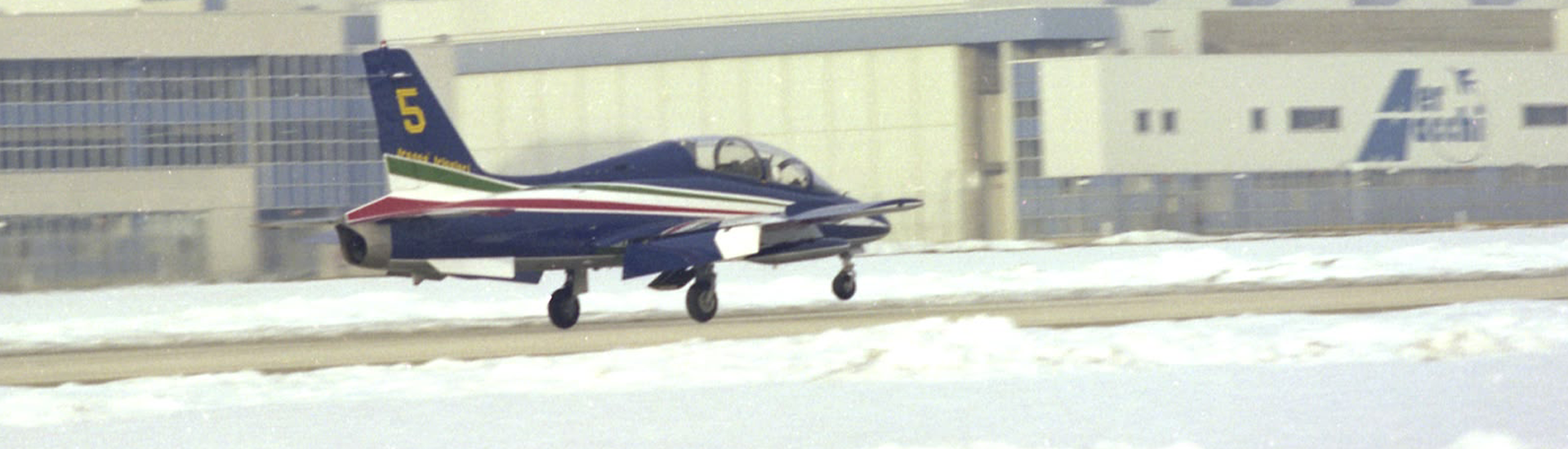
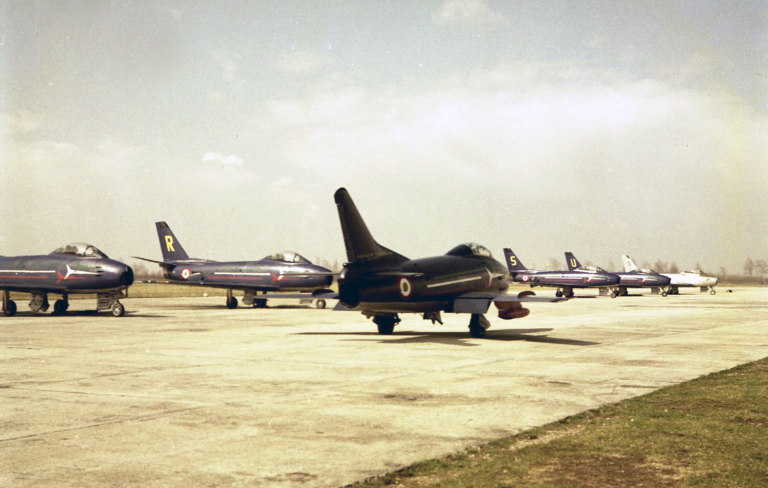
In the 1950s, as part of a NATO competition to develop a new light tactical support jet, engineer Giuseppe Gabrielli developed the G-91 prototype, which made its maiden flight on 9 August 1956, piloted by test pilot Riccardo Bignamini.
Manufactured at the Fiat Aviazione facilities in Turin, the aircraft was produced in several variants, including reconnaissance and training versions, and entered service with the Italian, German and Portuguese air forces.
It is 28 December 1963, a date destined to mark a turning point in the history of Italian aerobatics. For the first time, the PAN is preparing to operate on a permanent basis with a jet aircraft designed and built by Italian industry.
Until then, the Italian Air Force had predominantly used foreign-built aircraft, particularly the American F-86E Sabre, although other types had also been employed.
The G-91 marks a change of direction.
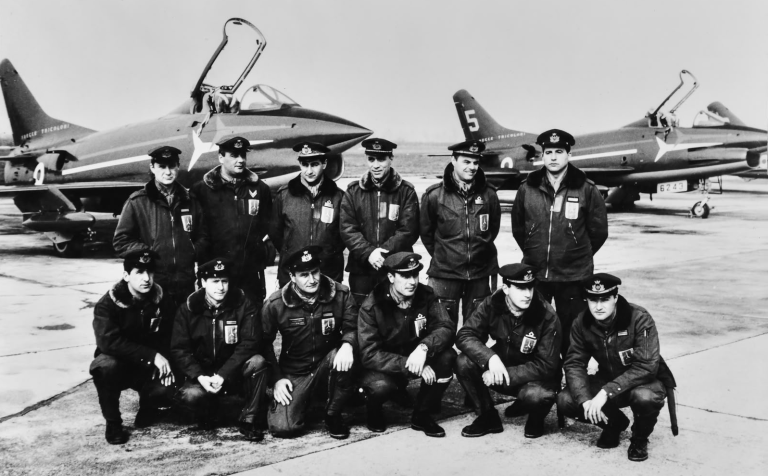
Meanwhile, the company that designed and built it was also undergoing significant changes.
In 1969, Fiat Aviazione became part of the newly established Aeritalia, which in turn came under the control of Finmeccanica, now Leonardo, in 1976.
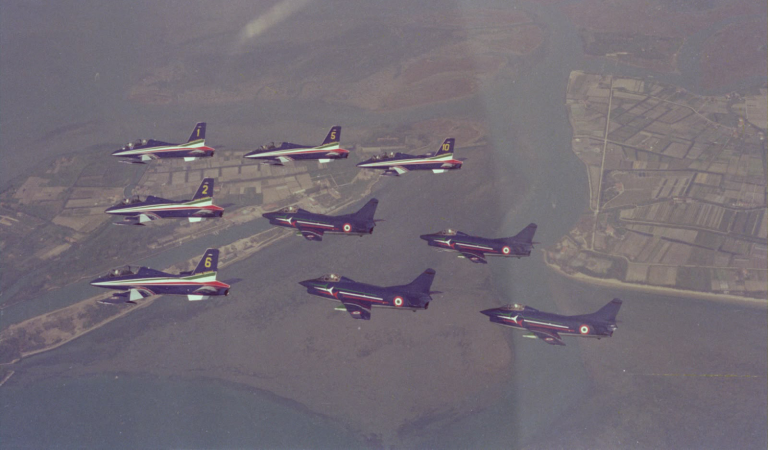
The Fiat G-91 intended for the PAN was suitably modified to meet the requirements of aerobatic flying. Among the most distinctive modifications were the installation of a smoke-generation system and underwing tanks for coloured smoke fluid, essential for creating the trails that accompany the team's aerobatic manoeuvres.
The introduction of the new aircraft into the team was completed during the 1964 season. It would serve the Frecce Tricolori for 18 seasons. Initially, the formation comprised four aircraft, later increasing to six and then nine. In 1966, the solo display pilot was also introduced, leading to the current ten-aircraft configuration, one of the defining features of the Frecce Tricolori, which remains the world's only jet aerobatic display team to fly a ten-aircraft formation.
In 1977, the solo pilot's so-called volo folle (crazy flight) made its debut, becoming one of the most spectacular and recognisable elements of the display programme.
The G-91 ended its career with the Frecce Tricolori in 1981, leaving behind an impressive record: almost 40,000 flying hours, 419 air displays and 108 flypasts.
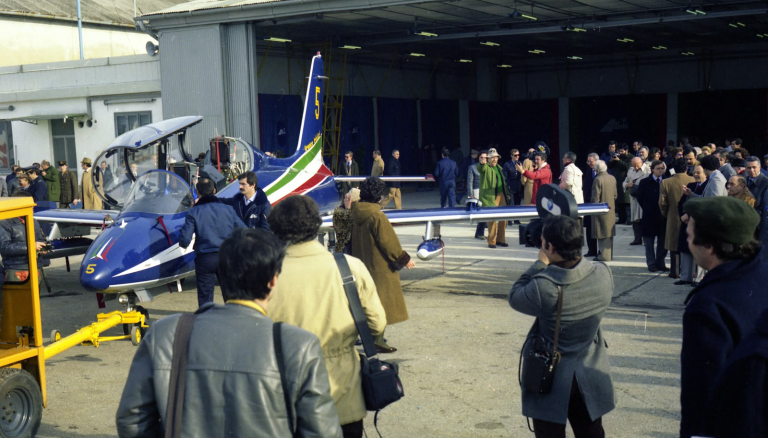
The year 1982 marks the beginning of a new era for the Frecce Tricolori with the arrival of the Aermacchi MB-339 PAN.
The first aircraft was formally delivered on 6 January 1982 at the Aermacchi facility in Venegono (Varese). On 27 April, during the official presentation, a mixed formation of MB-339s and G-91s flew over Rivolto (Udine), symbolically marking the handover between the two generations of aircraft.
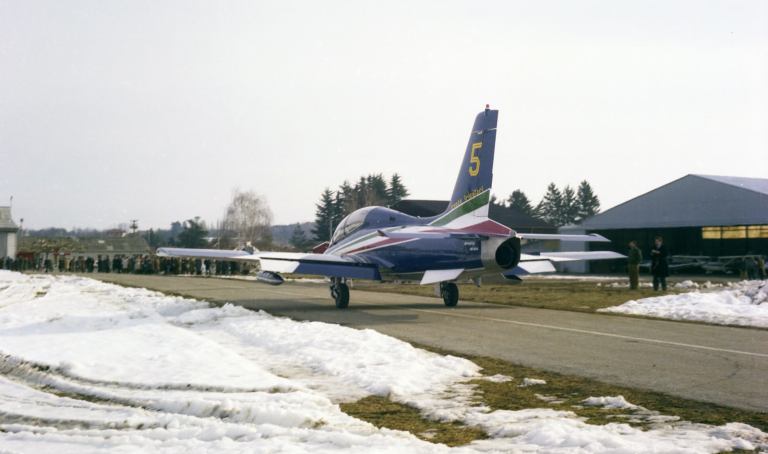
More than 200 MB-339 aircraft were manufactured in various versions and adopted by the Italian Air Force and numerous foreign air forces.
Due to its flying characteristics, the MB-339 enabled the team to expand its aerobatic repertoire further, including the execution of the Lomcovák, a manoeuvre normally associated with propeller-driven aerobatic aircraft.
Over more than forty years of service with the Frecce Tricolori, the MB-339 has accumulated more than 120,000 flying hours and participated in over 1,600 air displays and flypasts, carrying the Italian tricolour thousands of kilometres beyond Italy's borders.
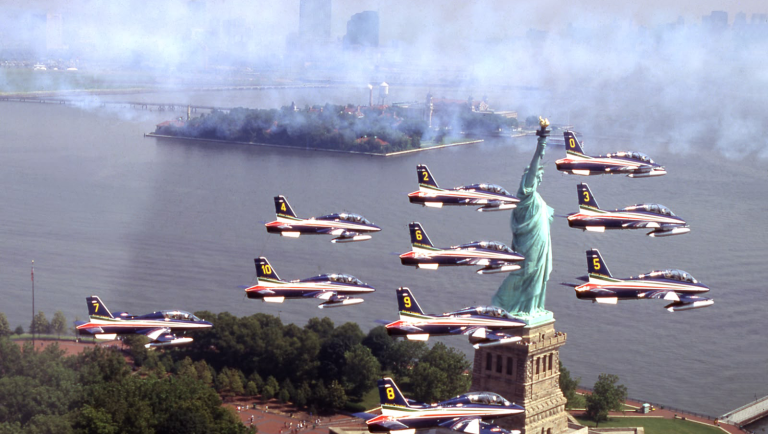
Among the most significant milestones in the MB-339's history with the Frecce Tricolori are the North American tours of 1986 and 1992.
The first showcased the excellence of the Italian Air Force overseas, while the second celebrated the 500th anniversary of Christopher Columbus's voyage.
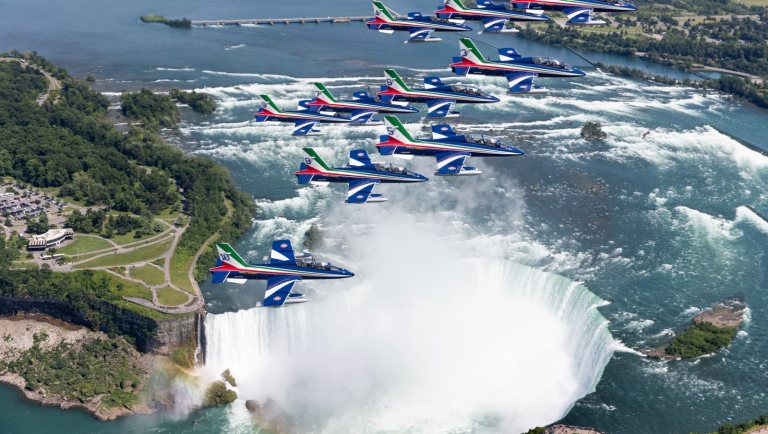
The 2024 North America Tour renewed ties with Italian communities across the Atlantic, continuing the celebrations of the Italian Air Force's centenary in 2023.
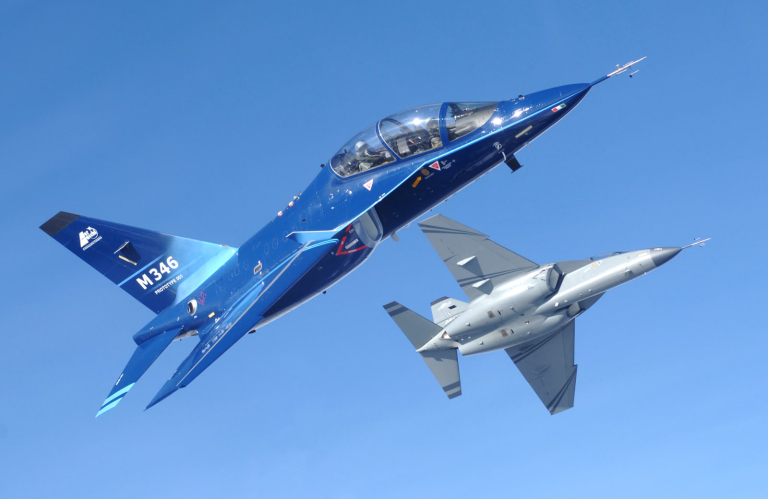
The M-346 Master programme was launched in the early 2000s. Its objective was ambitious: to develop an aircraft capable of preparing military pilots to operate the most advanced fighter aircraft, replicating their flying characteristics, systems and operational procedures.
The M-346 prototype made its maiden flight on 15 July 2004, piloted by Olinto Cecconello, the company's chief test pilot at the time.
This marked the beginning of a new generation of jet trainers : twin engines, digital flight controls, advanced avionics architecture and an integrated simulation system that enables live flying and virtual training to be combined.
In 2011, the aircraft received military certification and was acquired by the Italian Air Force under the designation T-346A.
The M-346 is also the principal training platform of the International Flight Training School (IFTS) in Decimomannu, Sardinia, an advanced training centre established through a partnership between Leonardo and the Italian Air Force, with support from CAE, to train Italian and international military pilots.
It is precisely this combination of performance, technology and controllability that led the Italian Air Force to select the M-346 as the future aircraft of the Frecce Tricolori.
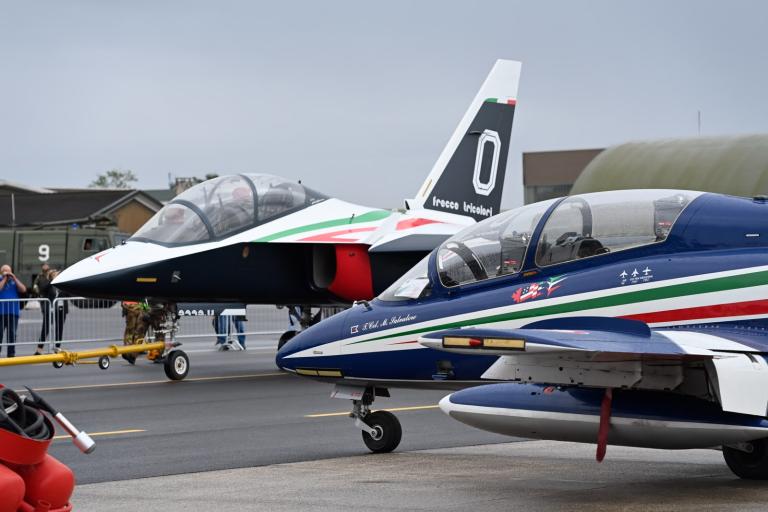
On 12 September 2024, the Frecce Tricolori returned from their 2024 North America Tour to the air base at Istrana (Treviso), home of the Italian Air Force's 51st Wing.
In the presence of numerous civilian and military authorities, the team's new aircraft was officially announced : the Leonardo M-346. The new livery, specially designed by Pininfarina to emphasise the dynamism of flight and the distinctive national colours, was also unveiled for the occasion.
After more than forty years of MB-339 service, the team began preparing for a new technological transition, adopting a new aircraft designed and manufactured entirely in Italy at Leonardo's Venegono facilities (Varese).
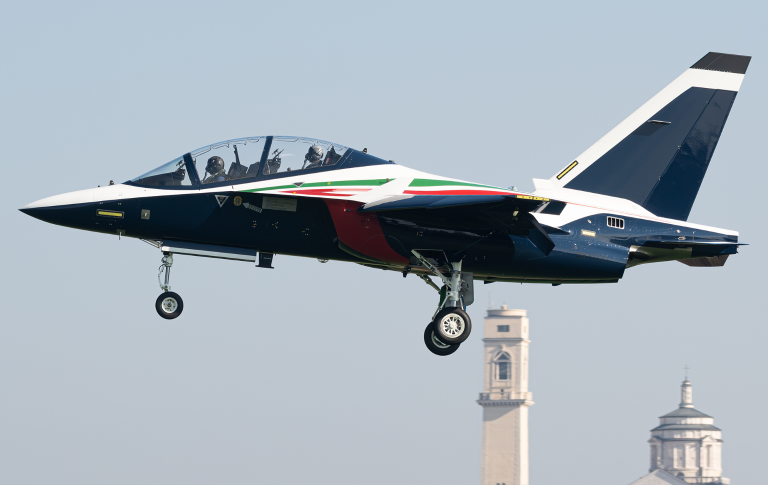
At Varese-Venegono Airport, the aircraft is rolled out of the hangar and positioned on the apron, alongside an MB-339 PAN undergoing maintenance.
It is an almost symbolic passing of the baton: two generations of aircraft, two key players in the team's history, side by side. After a briefing lasting approximately an hour, the pilots make their way to the aircraft, climb aboard and prepare for the flight. Almost all of the facility's more than 1,900 employees leave their offices to witness the occasion.
At exactly 12:20 p.m. on 29 October 2026, the first M-346 PAN, destined to become the new aircraft of the Frecce Tricolori, lifts off from Runway 35 at Venegono Airport.
It is the maiden flight of a new chapter in Italian aviation history.




 Aircraft
